


Now that our political system has given us a president-elect with no military or political experience, possibly aided by the direction of electronic shenanigans by a former KGB spy who’s now Russia’s leader, it’s becoming clearer that our system is, if not broken, then seriously malfunctioning.
But what can we do about it? Unfortunately, the system as it stands now benefits those who are in power to change that system. It would take a mammoth effort to convince two-thirds of the House and Senate to change the laws that help keep their two parties in power. It would be a Herculean undertaking to convince two-thirds of the state legislatures to vote to alter the Constitution by amendment, since it has never been done.
Pretend for a moment, however, that it were possible. Perhaps the cancer of a Trumputin Administration does so much damage to the body politic that a Constitutional chemotherapy would be embraced by the states or Congress. If so, here are the six state or national constitutional amendments I’d propose to fix American Democracy – and they don’t even require undoing Citizens United or abolishing the Electoral College.
Step One: Ranked-Choice Voting
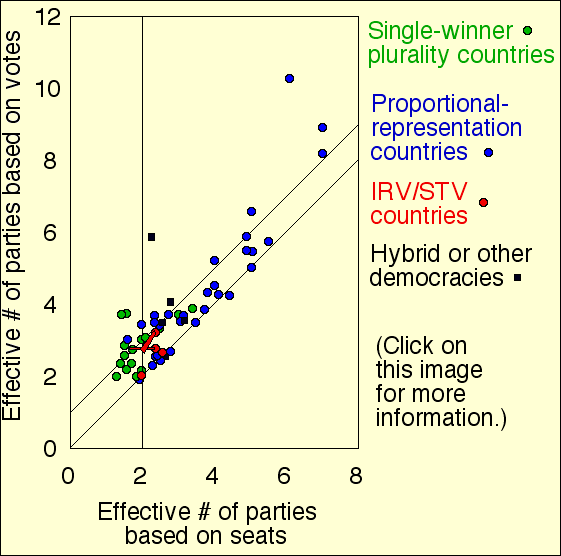
Homework: Visit rangevoting.org for the math, fairvote.org for the primer.
How it could happen: Individual states would pass citizen initiatives or legislative statutes to mandate voting system change.
Why it will not happen: Only 24 states have initiative power. The ones requiring a legislative statute will never do it, because it would require Dems & GOP to eliminate the system that keeps third parties at bay.
If we stick with “first past the post” voting, we will always have a duopoly in control. Today it’s Dems and GOP, 1,000 years from now it might be Yangs and Kohms, but it will always be two. (See Duverger’s Law at rangevoting.org.)
Ranked-Choice voting means you pick the candidates as you like in the order you like them.
For instance, maybe this election you’d have picked 1-Stein, 2-Johnson, 3-Clinton and not given any preference to Trump. We add up all the candidates’ #1 votes. Suppose it goes like this election:
48% Clinton; 46% Trump; 03% Johnson; 01% Stein
Since none get a majority of #1 votes, the last-place candidate (Stein) is dropped, but all her #2 votes are added to the remaining three candidates (so your Stein vote now goes to Johnson). Maybe that makes the results like so:
48% Clinton; 46% Trump; 04% Johnson
That still doesn’t give us a majority winner, so the third place finisher (Johnson) is dropped and Johnson’s and Stein’s votes are given to the highest-chosen candidate between Clinton and Trump (so your Stein vote now goes to Clinton, the highest-remaining choice you selected).
Maine just passed an amendment this election to make all their state and federal votes follow thin ranked-choice system. Numerous cities and counties use it. This will increase the viability of third parties, because they are no longer “spoiler votes”. It also guarantees that if one of the two-party candidates wins, it’s the one most palatable to the most people, instead of getting a Trump chosen only by 46% of the people who lost the popular vote by 2.5 million.
Step Two: Increase the House
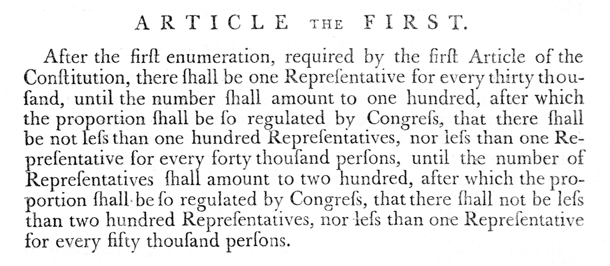
Homework: Learn about our original Bill of Rights at articlethefirst.net and thirty-thousand.org
How it could happen: Congress decides to finally ratify Article the First as the 28th Amendment to the Constitution.
Why it will not happen: Too many sparsely-populated interior state Senators and Representatives would not be onboard with reducing their power relative to big coastal states.
I saw a meme today that compared California with seventeen other red states that equal it in population. California pays more in taxes than those states combined, yet it has thirty-odd fewer Electoral Votes, 2 Senators to their 34, and only a couple more Reps in the House.
How is it fair that the votes of 3.7 Californians are equal to that of one Wyomingite when choosing our president?
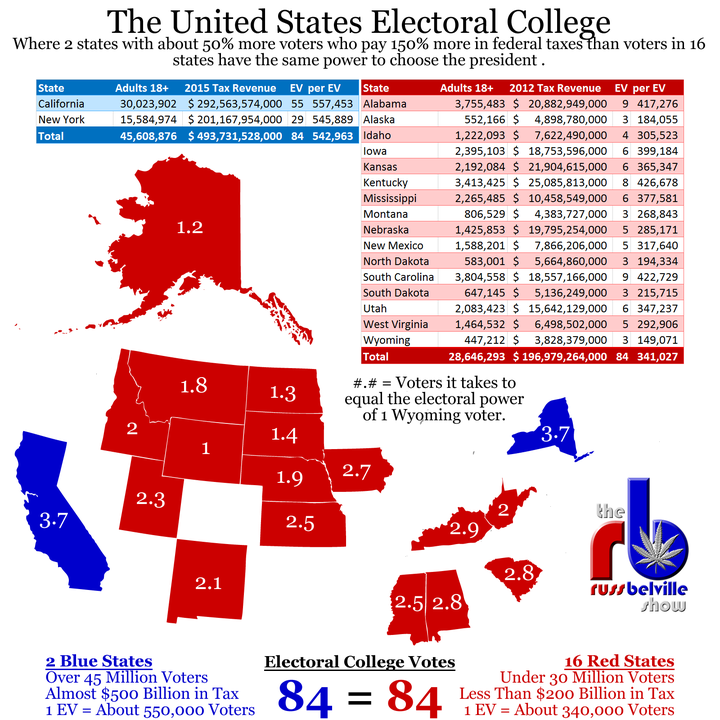
The reason is because one of the original twelve amendments to the constitution – Article the First – has never been ratified. The Bill of Rights you know and love are actually Articles the Third through the Twelfth. Article the Second, preventing Congress from raising its own pay, was finally ratified in 1992 as the 27th Amendment.
Article the First is the one that mandates that a congressional district can (eventually) represent no more than 50,000 citizens, rather than the average 700,000 we have today. It means we’d have a House of Representatives with about 6,400 congresspeople.
Sometimes people freak out over that – how could we have 6,400 people meeting and ever getting anything done? Well, gosh, we have only 435 now… how much are they getting done? What is it we’re afraid of… gridlock?
The answer is that we’d abandon the idea that our Reps (not our Senators) have to be on Capitol Hill meeting together in some building three days a week then flying home for the weekend. They’d stay home in their Districts, hearing from their constituents, each of whom has more influence as a 1/50,000th share than a 1/700,000th share of their votes. They’d meet, debate, and vote online… and then be right there in their home district to face the accolades or protests resulting from their vote.
Also as a result of increasing the House, the proportional representation in the Electoral College would be much ameliorated. California with 38,800,000 people would have 776 reps and 2 senators for 778 EVs, while Wyoming with 584,000 people would have 12 reps and 2 senators for 14 EVs. The California:Wyoming ratio of 39M:384K population is about 66:1. The new EV ratio of 778:14 is about 55:1. Our current EV ratio of 55:3 is about 18:1.
So the Electoral College would still imbue less-populated states with more electoral power than their population deserves, but not so much more that it takes 705,454 California voters to equal 194,666 Wyoming voters (3.7:1). Instead, one EV would represent 49,871 Californians and 41,714 Wyoming voters (1.2:1).
Step Three: Paper Trail Vote by Mail
Homework: NCSL on All-Mail Elections ncsl.org and votingbymail.com.
How it could happen: State initiatives and legislative statutes to change voting systems.
Why it will not happen: Too many GOP states rely on voter suppression to maintain power.
Suppose you were a rich bastard and you wanted to make sure that poor people couldn’t easily vote, so your rich bastard friends can get elected and pass laws favoring rich bastards. How would you go about designing a voting system to that end?
First thing you’d do is make sure to hold the vote in person at a specific day. Since you’re rich, you can rearrange your schedule to have your driver take you to the polls. Poor folks might have a tougher time taking time off of working two jobs, or may have transportation difficulties to get to the polls.
Next, you’d schedule that specific day on a Tuesday. If it was on a Saturday or Sunday, more poor people would have the day off and could go vote. If it were a Monday or a Friday, a few might be able to rearrange sick or vacation days to make a three-day weekend out of it. But on a Tuesday (or Wed/Thu), you make it so someone has to take a day off on the middle of the week. And since all the poor people are trying to get that Tuesday off, many won’t be able to.
Then, you’d make sure that at these in-person polling places, they are open, well-staffed, and with plenty of ballots and machines. Your Richie Rich precinct will be an easy ten or twenty minutes hopping out of the Mercedes, marking a ballot, and heading out for an afternoon tee time. The polls for the poors, however, will be understaffed, machines will break, there won’t be enough ballots, and the lines will last four to six hours. Many of the poors in line will have to abandon the wait and get back to work!
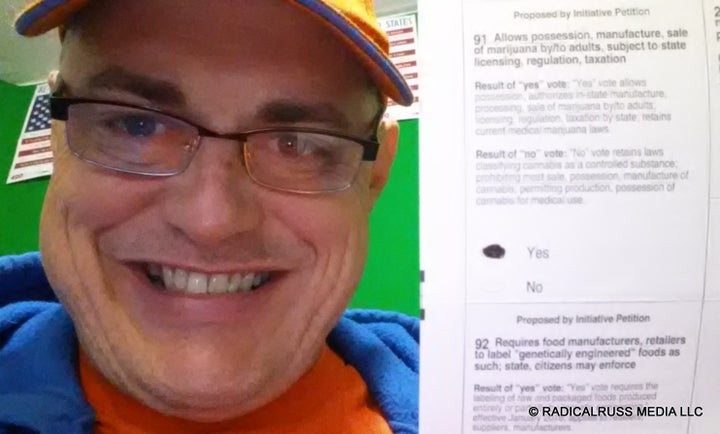
Since 2000, my state of Oregon has had exclusive vote-by-mail. You get a election guide from the state that gives you time to research every candidate and initiative. You can fill out that ballot anytime and for just the price of a stamp, you mail it in. There’s an instant paper trail, no need for a day off, no need to stand in line.
Step Four: Shorten the Election Season

Homework: Sign Sheryl Crow’s petition to DNC and RNC to shorten the primary season.
How it could happen: A simple decision by those two private party organizations to abide by the petition.
Why it will not happen: Longer campaign seasons mean more spending on TV campaign ads, salaries for political hacks, and attention for small states.
No other nation has such a protracted election season for president. We are getting to the point where after the midterm election, there is already a two-year POTUS campaign going on.

Over that drawn-out season, there becomes a greater feeling of tribalism. Big money donors can bombard voters with months’ worth of misleading ads. People start to tune out the politics after so much.
Instead, let’s start our presidential election in September. Set up the states to have regional “Super Tuesdays” (but again, see Step Three – we’ll do it by mail) that follow a Monday Debate hosted in that region every week. This would force the candidates to campaign in each region’s states more.
Also, rotate those primaries every election, so each region has its shot at being the first to vote or last to vote. No more kowtowing to Iowa and New Hampshire in February.
So instead of our election season feeling like an extended marathon from before the February Iowa primaries on, it would feel more like the NCAA Basketball Tournament, where we focus our attention on a series of weekly contests leading to a winner.
Step Five: A Federal Term Limits Amendment
Homework: TermLimits.org (though this is the Sen. Vitter-sponsored 3x Rep / 2x Senator version, no repeal of 22nd Amendment)
How it could happen: Two-thirds of Congress or two-thirds of state legislatures call for a 28th Amendment repealing the 22nd Amendment and creation of a 29th Amendment establishing term limits.
Why it will not happen: Try convincing a bunch of >=2nd-term senators and >=6th-term congressmen to vote for their own unemployment.
For the longest time, I’ve hated the concept of term limits. Without the two-term limit on president, we wouldn’t be having this Trump problem. Besides, if someone is a good politician / public servant, why should we flush them?
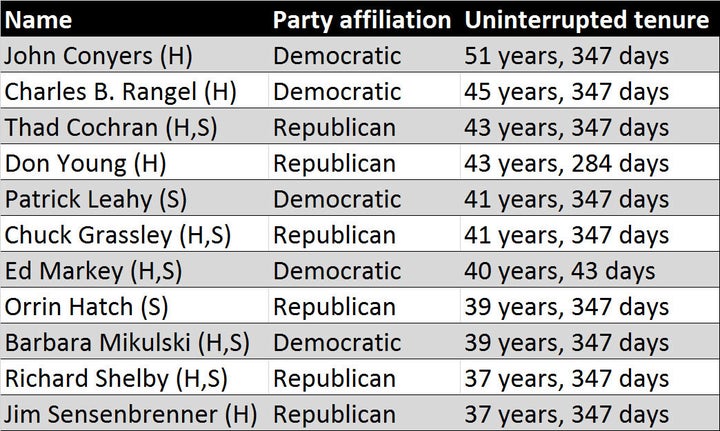
But my ideological purity on the issue has been undermined by practical considerations – namely, money and incumbency lead to something like a 95%+ re-election rate.
I can’t believe that 95%+ of our elected officials are good politicians / public servants.
I suggest we repeal the 22nd Amendment limiting presidents to two terms and replace it with a new term limits amendment that limits holding a position in federal office any longer than twelve years.
If you want to be a Congressman, you get six two-year terms, max. A Senator gets two six-year terms. A President gets three four-year terms. A Supreme Court Justice gets one twelve-year term.
However, you are allowed to serve in more than one federal office. Thus, you could be a six-term Congressman, then become a two-term Senator, then become a three-term President, then serve twelve years on the Supreme Court.
This way, if someone is that good politician / public servant, they could theoretically serve their country for 48 years… but ya gotta keep moving up. No more incumbent complacency from being a multi-decade unbeatable congressional barnacle.
Step Six: Nationwide Citizen Initiative Petitions & Referenda
Homework: Statewide Initiatives & Referenda at iandrinstitute.org and ncsl.org.
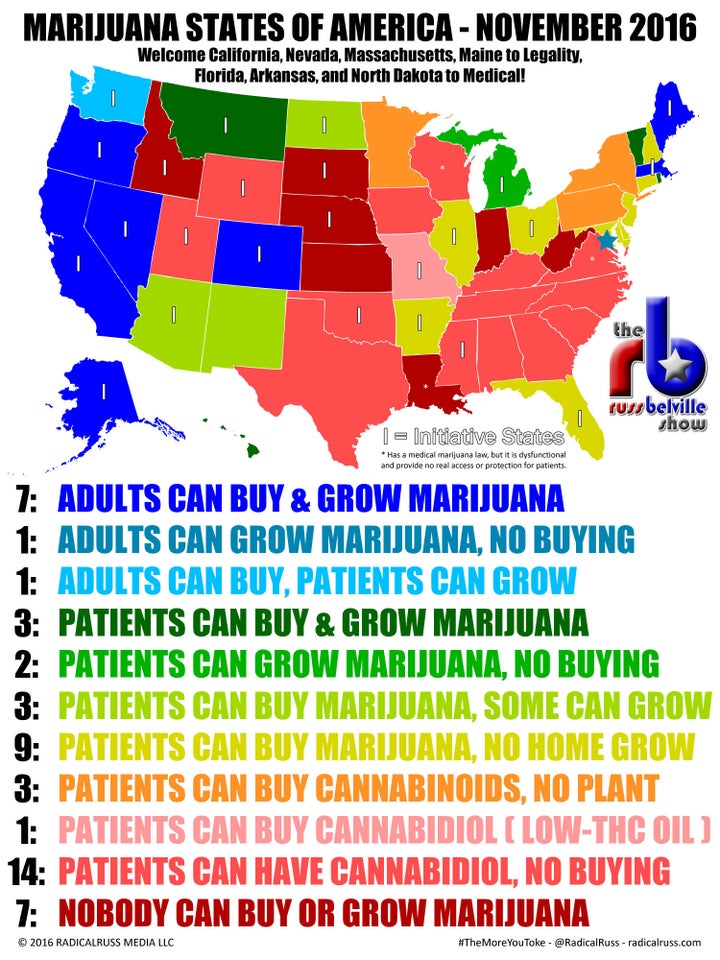
How it could happen: Legislatures in the 26 states without initiative power enact constitutional amendments enabling the process.
Why it will not happen: See the rest of this list for the things that initiative power could produce that those in power would not want voted on.